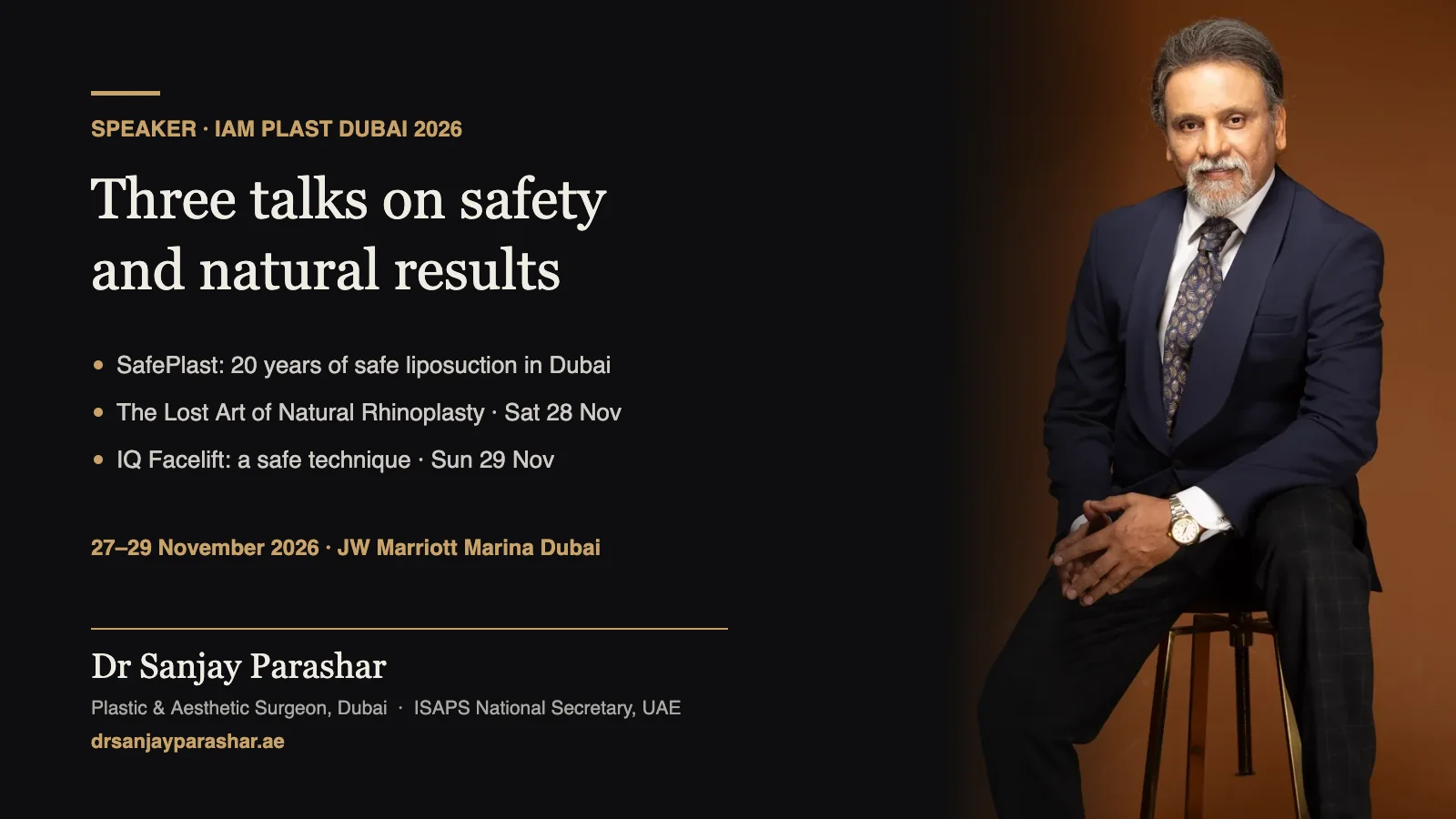
Dubai plastic surgeon Dr Sanjay Parashar, ISAPS National Secretary for the UAE, will deliver three oral presentations at IAM PLAST Dubai 2026, the International Aesthetic & Plastic Surgery Meeting, held at JW Marriott Marina Dubai from 27 to 29 November 2026. The meeting is organised with the Emirates Plastic Surgery Society and the Arab Association of Surgical and Medical Aesthetics (AASMA).
Dr Sanjay Parashar’s presentations at IAM PLAST Dubai 2026
SafePlast: Rethinking Liposuction – What Are We Overlooking? 20 Years of Safe Liposuction in Dubai. The planning and technique decisions that keep liposuction safe, drawn from two decades of practice in Dubai.
The Lost Art of Natural Rhinoplasty – Stop Chasing Caucasian Noses, Respect Ethnic Anatomy (Session 18: My Approach to Rhinoplasty, Saturday 28 November, 4:40 pm). Why rhinoplasty should refine a patient’s own ethnic features rather than impose a single ideal.
IQ Facelift: A Safe Technique in Rhytidectomy Integrating Anatomical Understanding, Infiltration Strategy, Internal Quilting and Consistency (Session 22: Difficult Cases and Complications in Face Lift, Sunday 29 November, 8:50 am). His approach to safer, consistent facelift surgery.
“Safety isn’t a single step in the operating room. It starts with patient selection, respect for anatomy and a plan built around the individual. Whether it’s a nose, a face or body contouring, the aim is a natural result that still looks right years later.”
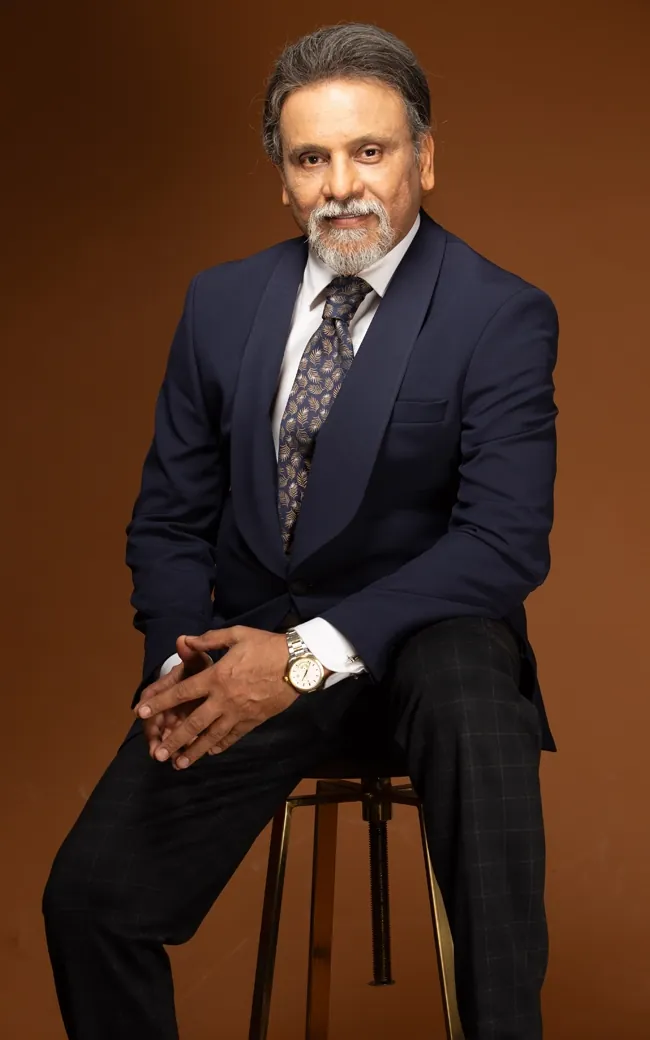
Dr Sanjay Parashar
About Dr Sanjay Parashar
Dr Sanjay Parashar is a consultant plastic and aesthetic surgeon in Dubai who operates at Dubai London Hospital, Jumeirah. He has performed rhinoplasty since 1993 and practised in Dubai since 2005, with more than 40,000 procedures, including over 10,000 liposuctions and more than 3,000 rhinoplasties. He is ISAPS National Secretary for the UAE and an International Visiting Professor for ASPS. He founded Cocoona Centre for Aesthetic Transformation in Dubai (2009) and New Delhi (2013).
Earlier this year he was international faculty at GPSACON 2026 in Ahmedabad, where he gave a masterclass on high-definition liposuction.
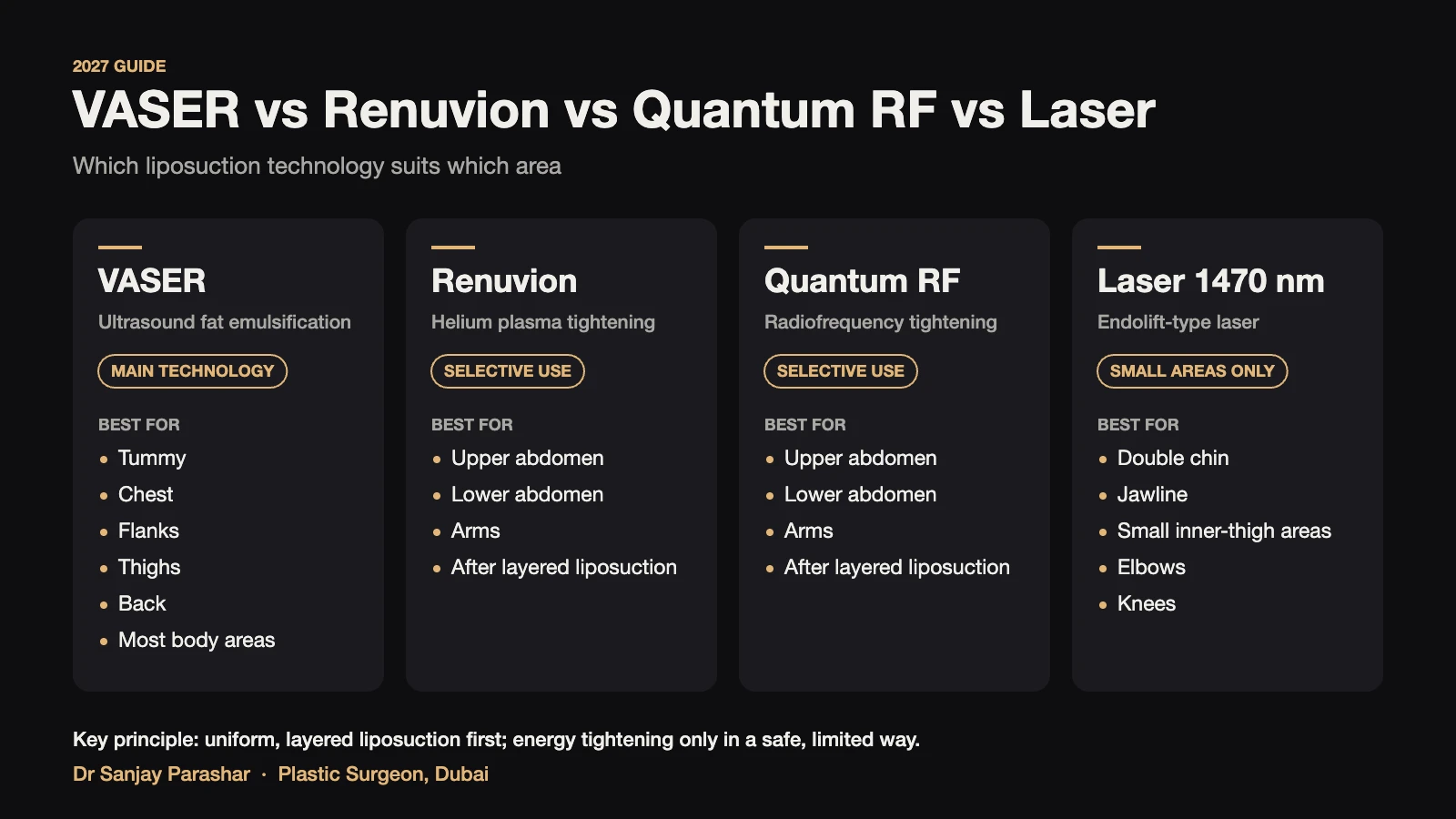
In 2027, the most useful liposuction technology is still VASER. It emulsifies fat without trauma, which allows even fat removal, smooth contours and good skin draping. Laser works well for small areas such as the double chin and jawline. Renuvion or Quantum RF can add skin tightening on the abdomen and arms, used safely and sparingly. I have worked with every generation of these tools since 1998, and the key is still uniform, layered liposuction.
This guide explains how each technology works, where each one fits, and how I decide between them for patients in Dubai.
My journey with liposuction technologies
I have tried most technologies as they arrived, kept the ones that worked and dropped the ones that did not.
Years
Technology
What I found
1998–99
First-generation ultrasound-assisted liposuction, Bahrain, with my mentor Dr Tariq Saeed
We performed several cases with no complications and good emulsified fat aspiration. It offered no clear advantage over our traditional technique, so we stopped
2005
Traditional liposuction, Dubai
No assisting technologies were available in Dubai yet
2007–08
SmartLipo laser
I introduced it, but found it not powerful enough for significant improvement
2009–10
1470 nm laser (Endolift)
Kept for small areas with thin skin
2009–10 onwards
VASER, 3rd then 4th generation
Very useful; it became my main technology
2013–15
BodyTite (radiofrequency-assisted liposuction)
Used for two years, then stopped: tightening was not adequate on the tummy and other large areas
2018–19 onwards
J-Plasma, later renamed Renuvion
Learned a safe technique; I use it selectively
How each technology works
All of these are tools used alongside liposuction. None of them removes fat on its own; the suction cannula still does the shaping.
VASER (ultrasound-assisted liposuction). A thin probe sends ultrasound energy into the fat after the area is infiltrated. The energy loosens and emulsifies fat cells while largely sparing nerves, vessels and connective tissue. The loosened fat is then removed with a gentle suction cannula. It works best in firm or fibrous fat, such as the back, male chest, flanks and areas treated before.
Renuvion (helium plasma with radiofrequency). A fine wand is passed under the skin after fat removal. It delivers controlled heat to the connective tissue under the skin, which contracts it. Cold helium plasma limits how far the heat spreads. It is used for loose skin that is not loose enough to need excision. In the US, its APR handpiece is FDA-cleared for coagulation and contraction of soft tissue, including use after liposuction.
Laser (1470 nm, such as Endolift). A thin laser fibre heats and melts fat through a tiny entry point and tightens skin locally. It is a good technology for small areas: double chin, jawline, small inner-thigh areas, elbows and knees. For larger areas such as the tummy, chest, flanks and thighs, it is not effective enough.
Radiofrequency (such as Quantum RF). A probe under the skin delivers controlled radiofrequency heat to contract the tissue. Like Renuvion, it can help on the upper and lower abdomen and the arms. Earlier radiofrequency devices I used did not tighten large areas adequately.
VASER vs Renuvion vs laser at a glance
VASER
Renuvion / Quantum RF
Laser (1470 nm)
What it does
Emulsifies fat atraumatically before suction
Contracts tissue under the skin with controlled heat
Melts fat and heats skin in a small zone
Best for
Most areas, including tummy, chest, flanks and thighs
Upper and lower abdomen, arms
Double chin, jawline, small inner-thigh areas, elbows, knees
Skin tightening
Good skin draping through even fat removal
The main purpose; used safely and sparingly
Local only
Large areas
Yes
After layered liposuction
Not effective enough
How I use it
Most of my cases
Selectively
Small areas only
Recovery is driven more by how much is treated than by the device. Most patients walk the same day and wear a compression garment for 6 to 8 weeks.
How I choose between them
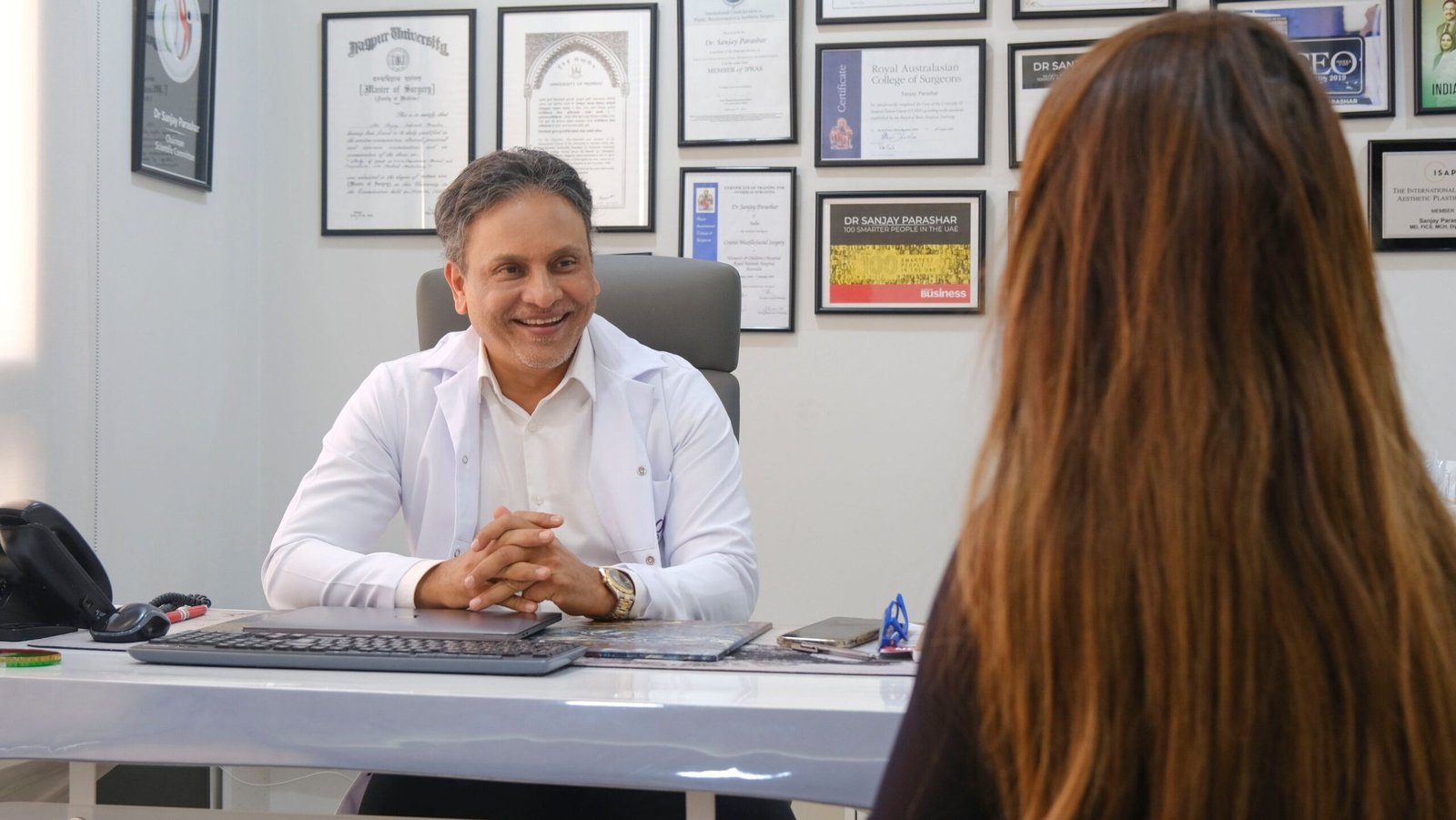
I decide at the consultation, after examining the fat and the skin, not from a menu.
VASER is my default for most areas. It lets me remove fat evenly with gentle 3 to 5 mm Mercedes cannulas, never sharp multi-hole cannulas.
Renuvion or Quantum RF is added selectively: mainly the upper and lower abdomen and the arms, when the skin is loose but does not need a skin-removal operation.
Laser is reserved for small areas: double chin, jawline, small inner-thigh areas, elbows and knees.
The key to skin tightening is not the energy device. It is uniform, laminated (layer-by-layer) liposuction, which lets the skin contract evenly. Only then do I add Renuvion or Quantum RF, in a safe and limited way. Too much heat under the skin risks burns and excessive internal scarring, and preventing that matters more than chasing extra tightening.
Every case starts with my stratified infiltration technique (SIT). I infiltrate the deep layer first, then the middle, then the superficial layer, using my standard solution. This limits bleeding and bruising and makes every device work more evenly. I use wet or superwet infiltration rather than classical tumescent.
What matters more than the machine
A good result depends on planning and safety more than on which device is in the room.
Safe volume. I work within DHA limits: up to 5,000 ml per session, and 2,000 ml when combined with a tummy tuck or body lift.
Fat left behind. I leave about 1.5 cm of fat in natural grooves, 2 cm elsewhere, and 2.5 cm where skin elasticity is poor. Over-thinning causes dents and irregularities that no technology can undo.
Proportion. I treat the areas that give the most benefit to your overall shape, following my APPEAL planning framework.
Aftercare. Incisions in dependent areas are left open to drain, lymphatic drainage starts early, and the garment is worn in two stages for 6 to 8 weeks. Controlled exercise usually resumes within 10 days.
Follow-up. I see patients at 24 hours, 5 days, 2 weeks, then 1, 3 and 6 months and 1 year.
Frequently asked questions
Is VASER better than traditional liposuction?
VASER makes fat removal gentler and more even, especially in fibrous areas. The result still depends on the surgeon’s planning and technique.
Does Renuvion replace a tummy tuck?
No. Renuvion helps mild to moderate skin looseness. Hanging skin or separated muscles still need a tummy tuck, sometimes a mini tummy tuck combined with liposuction.
Is laser liposuction good for large areas?
No. Laser is good for small areas such as the double chin, jawline, elbows and knees. For the tummy, chest, flanks and thighs it is not effective enough, which is why I use VASER there.
Can these technologies be combined?
Yes. Many of my patients have VASER for fat removal and, where needed, limited Renuvion or Quantum RF on selected areas in the same operation.
Which technology will I need?
That is decided after an in-person examination of your fat, skin quality and goals. Book a consultation with Dr Sanjay Parashar in Dubai to plan yours.
Short answer: BBL vs SGL is not a choice between two different goals. Both reshape the buttocks using your own fat. The difference is how the fat is placed. A safe gluteal lift (SGL) uses ultrasound guidance, careful volume control and a withdrawal injection technique, combined with liposuction around the buttocks, to create a natural contour with safety at the centre of the plan.
Dr Sanjay Parashar has performed buttock fat grafting in Dubai since 2006
I have been performing the Brazilian butt lift (BBL) in Dubai since 2006, and my patients have come through safely. About four years ago I moved my practice to the SGL – the safe gluteal lift. In this article I explain why, what I learnt along the way, and how to decide whether buttock fat grafting is right for you.
What is a traditional BBL?
A Brazilian butt lift removes fat from areas such as the abdomen, flanks and back with liposuction, purifies it, and injects it into the buttocks to add volume and shape. When it is done well, the result is natural because it uses your own tissue rather than an implant.
Over the years, however, the procedure has attracted worldwide safety concerns, and professional societies have issued guidance on how and where fat should be placed. The main lesson for surgeons has been that technique – especially the depth at which fat is injected – matters enormously.
What I learnt from 20 years of BBL in Dubai
In all my years of performing BBL, one patient developed fat necrosis – an area where some of the grafted fat did not survive and became firm. It resolved, but it taught me two lessons that still shape every buttock procedure I perform:
Adequate volume, balanced to the host. Grafted fat survives only if it can pick up a new blood supply from the surrounding tissue. The volume must be balanced against what the “host” area can support. Putting in too much in one place starves the graft; putting in the right amount, spread correctly, lets it vascularise and survive.
Two weeks of rest from pressure. Pressure on newly grafted fat reduces its blood supply. I now ask every patient to avoid direct pressure on the buttocks for two weeks, so the graft can settle and establish itself.
What is an SGL (safe gluteal lift)?
SGL stands for safe gluteal lift. It has the same aim as a BBL – a fuller, better-shaped buttock using your own fat – but every step is designed around safety and a natural contour. I have performed SGL for about four years, and it rests on four principles:
1. Volume control
I plan how much fat each area can safely receive, rather than chasing the largest possible size. Controlled volume protects graft survival and gives a more natural shape.
2. Ultrasound-guided (USG) fat placement
Ultrasound lets me see the layers beneath the skin while I work, so I can confirm where the fat is being placed throughout the procedure, rather than relying on feel alone.
This matters because the buttock has two layers of fat, and they behave differently:
Superficial (areolar) fat – a compact layer held together by an extensive network of fibrous septa. These fibrous bands are what cause dimpling and cellulite. This layer predominates in the lower part of the buttock.
Deep (sublamellar) fat – a looser layer that lies deeper within the fat, still above the muscle. It is more abundant in the upper quadrants of the buttock.
My technique follows this anatomy. In the upper quadrants, I place fat in the deep sublamellar fat layer to build projection. In the lower quadrant, I place fat in the superficial layer while releasing the fibrous septa, which helps improve dimpling and cellulite at the same time as adding shape. In selected patients I also combine the SGL with Avéli, a minimally invasive treatment that releases the fibrous bands responsible for cellulite.
3. Withdrawal injection technique
Fat is injected only while the cannula is being withdrawn, in small amounts along many fine tunnels. This spreads the graft evenly, gives each small parcel of fat the best chance of picking up a blood supply, and avoids depositing a large amount in one spot.
4. Sculpting around the buttock, not just adding to it
A beautiful buttock is as much about what surrounds it as what is added to it. With SGL I combine fat grafting with liposuction of the surrounding areas to reshape the whole contour:
Sacral area – to create the “Venus dimples” just above the buttocks
Above the iliac crest (love handles) – to define the waist and make the buttock look fuller by contrast; see waist liposuction.
Saddlebags and trochanteric fat on the outer thighs – to smooth the hip-to-thigh line
Inner thighs – to refine the gap and balance the silhouette; see thigh liposuction.
Banana roll – the fold under the buttock, which shapes where the buttock ends and the thigh begins
All of these areas play a role in reshaping a natural buttock contour. Often, refining them achieves more than adding a large volume of fat.
BBL vs SGL: side-by-side comparison
Traditional BBL
SGL (safe gluteal lift)
Goal
Fuller buttocks using your own fat
Fuller, natural contour using your own fat
Fat placement
Guided by the surgeon’s feel and experience
Ultrasound-guided, with the placement checked throughout
Volume
Often focused on maximum size
Controlled to what the tissue can support
Injection technique
Varies between surgeons
Withdrawal technique, small parcels, many tunnels
Surrounding areas
Liposuction mainly as a fat source
Liposuction used to sculpt sacrum, waist, saddlebags, inner thighs and banana roll
Aftercare
Pressure avoidance
Two weeks of no direct pressure, compression and early walking
The BBL risk I see most today: too much growth
Grafted fat that survives behaves like the fat it came from – it grows and shrinks with your weight. Today, one of the problems I see most often is buttocks that have grown too large after a BBL, either because too much fat was grafted or because the patient gained weight afterwards. These patients sometimes need liposuction to reduce the buttocks and restore balance.
This is another reason I favour volume control. A buttock that looks right on the day of surgery should still look right if your weight changes a little over the years.
Skinny BBL and Skinny SGL for slim patients
Slim patients often assume they cannot have buttock fat grafting because they have little fat to spare. In many cases a “skinny BBL” – or in my practice, a skinny SGL – is still possible. Because the volume available is smaller, the result depends even more on sculpting the surrounding areas, such as the waist, sacrum and banana roll, so that a modest amount of grafted fat creates a visible change in shape. Whether you have enough fat is something I can only confirm at an in-person examination.
Who is a good candidate for SGL?
Adults in good general health, at or near a stable weight
Enough fat in donor areas such as the abdomen, flanks or back – even a small amount can work in slim patients
Non-smokers, or patients willing to stop before and after surgery
Patients who want a natural, proportionate shape rather than the largest possible size
Patients bothered by dimpling or cellulite on the buttocks, which can be improved at the same time
Patients able to follow two weeks of pressure avoidance and wear compression as advised
If you are still losing weight, or planning a pregnancy, it is usually better to wait.
Recovery after SGL in Dubai
Most patients walk on the same day. For two weeks you should avoid direct pressure on the buttocks – this protects the grafted fat while it establishes a blood supply. You will wear compression garments over the liposuction areas, and we will guide you on sleeping position, sitting and returning to work. If you are travelling to Dubai for surgery, we will plan your stay around your follow-up appointments. Our guide on how to prepare for plastic surgery explains what else to expect.
Frequently asked questions
Is SGL the same as a BBL?
SGL has the same goal as a BBL – shaping the buttocks with your own fat – but it is performed with ultrasound guidance, volume control, a withdrawal injection technique and sculpting liposuction around the buttocks.
Is BBL in Dubai safe?
Every operation carries risk, and safety depends on the surgeon, the technique and the hospital. That is why I perform the SGL with ultrasound guidance and careful volume control, and why every patient is assessed in person before surgery.
How long do SGL results last?
Fat that survives the first few months is generally long-lasting, but it behaves like your other fat: it will grow if you gain weight and shrink if you lose it. Keeping a stable weight helps you keep your shape.
Can I sit down after an SGL?
You should avoid direct pressure on the buttocks for two weeks. We will advise you on how to sit, travel and sleep during this time.
Can a BBL that is too large be corrected?
Often, yes. Liposuction can reduce buttocks that have become too large after a BBL or weight gain, and the surrounding areas can be re-sculpted to restore balance. An assessment is needed to plan this.
The bottom line
I have performed buttock fat grafting in Dubai since 2006, and the move to SGL reflects what that experience has taught me: control the volume, see where the fat goes, place it gently, protect it while it heals, and sculpt the whole contour rather than simply adding size. As the International Society of Aesthetic Plastic Surgery (ISAPS) National Secretary for the UAE, I place patient safety at the centre of every plan. Learn more on my BBL in Dubai and butt augmentation pages.
Short answer: “Ozempic face” – hollowing and sagging after rapid weight loss – is common, and the right Ozempic face treatment depends on what has actually changed. If the main problem is lost volume, carefully placed filler or fat can be enough. If the skin and deeper tissues have dropped, adding more filler tends to make the face look heavy, and a lift is usually the more natural answer.
Dr Sanjay Parashar, consultant plastic surgeon in Dubai
Weight-loss injections such as Ozempic, Wegovy and Mounjaro have become part of everyday life in Dubai. Many patients are delighted with their new weight – but not always with what they see in the mirror. Cheeks look hollow, the jawline softens, and the face can look older or more tired than before.
This change is often called “Ozempic face”. It is not a medical diagnosis, but it describes a real and widely recognised pattern in aesthetic practice. In this article I explain why it happens, why filler alone is not always the answer, and when a lift makes more sense.
What weight-loss medicines do to the face
When you lose weight quickly, you lose fat everywhere – including the fat pads that support your cheeks, temples and midface. At the same time, the skin may not shrink back at the same speed. The result can include:
Hollow cheeks and temples
Deeper lines from the nose to the mouth
Softening or sagging of the jawline and neck
Skin that looks thinner or looser
Two different things are happening at once. The first is volume loss: the face has less fat to fill it. The second is loss of support: the skin and deeper tissues that were stretched over that fat now have less to sit on, so they descend. Every patient has a different mix of the two, and that mix decides the treatment.
How much this happens varies a lot from person to person. Age, genetics, skin quality, sun exposure, smoking and how much weight you lost – and how fast – all play a part.
Why stacking filler can look heavy
The quickest answer is often “add filler”. Sometimes that is right. But filler adds volume – it does not lift skin that has become loose. If a face has lost both volume and support, the temptation is to keep adding filler to chase the sagging. The face then gets fuller rather than lifted, and it can start to look heavy, wide or unnatural, particularly in the lower cheeks and around the mouth.
Filler also has weight of its own. Placed into tissue that is already descending, it can add to the downward pull rather than correcting it. That is why I would rather tell a patient that they need less filler, or a different approach, than keep layering product into a face that needs support.
Ozempic face treatment options: why assessment comes first
At my clinic, every patient starts with a full facial assessment. I look at:
Volume: where fat has been lost, and how much
Support: whether the deeper tissues and skin have dropped
Skin quality: thickness, elasticity and sun damage
Neck and jawline: loose skin, residual fat and muscle bands
Your goals: what bothers you most, and what you want to keep
What you see
Main cause
Options we may discuss
Hollow temples and cheeks, skin still firm
Volume loss
Cleopatra Lift, filler or fat transfer
Hollowing plus early sagging of the cheeks
Volume loss and some descent
Combination of volume restoration and lifting
Loose skin, deep folds, heavy lower face
Loss of support and excess skin
IQ Lift or face lift
Loose neck skin, softened jawline
Excess skin, sometimes residual fat
Neck lift, sometimes with chin liposuction
This table is a general guide only. The right plan for you can only be confirmed after an in-person examination.
Cleopatra Lift and IQ Lift: who suits which
Cleopatra Lift
The Cleopatra Lift helps lift the temples, brows and malar (cheek) region, using fillers placed in the appropriate areas and amounts. It is best suited to patients whose main problem is volume loss and whose skin still has reasonable elasticity – typically people who have lost a moderate amount of weight and notice hollowing more than sagging.
IQ Lift
The IQ Lift is a face lift for patients with excess skin. Performed with the IQ Lift technique, it is designed to support a faster recovery, minimise the risk of haematoma and give a long-lasting result. It suits patients whose skin and deeper tissues have descended after weight loss – where more filler would only add weight rather than lift. See my face lift in Dubai page for more on surgical facial rejuvenation.
Combining the two
Many faces after significant weight loss need both: support restored with a lift, and volume replaced where it was lost. When that is the case, we plan the order and timing together so the result looks balanced rather than overfilled or tight.
The neck and jawline
Weight loss often shows first along the jawline and neck. Where the problem is loose skin, a neck lift tightens and redefines the neck. Where a small pocket of fat remains under the chin despite the weight loss, chin liposuction may help, sometimes alongside a neck lift. Filler along the jawline can sharpen definition in selected patients, but it is not a substitute for removing loose skin.
What about the rest of the body?
The face is rarely the only place that changes. Many patients also notice loose skin on the arms, thighs and abdomen. I cover those options in a separate article: Loose Skin After Ozempic or Mounjaro: Arm, Thigh and Body Lift in Dubai. For men, my V Sculpt approach uses high-definition liposuction to reduce residual fat around the chest, armpits, flanks and lower back for a sculpted V-shaped torso.
Timing your lift: wait until your weight is stable
For surgical options, I generally recommend waiting until your weight has been stable for a period of time. If your face is still changing, the result of any procedure can change with it. If you are still losing weight, non-surgical options can be a sensible bridge – but avoid committing to large amounts of filler while your face is still settling.
Please also tell us about all your medicines, including weight-loss injections. Some may need to be paused before anaesthesia, and we will coordinate this with your prescribing doctor. Our guide on how to prepare for plastic surgery explains what else to expect, and Are Plastic Surgery Results Permanent? covers how long results can last.
Frequently asked questions
Is “Ozempic face” permanent?
The fat loss itself does not reverse unless you regain weight, and loose skin does not fully tighten on its own. Some patients notice a modest improvement as their skin adapts in the months after weight loss, which is another reason to wait until your weight is stable before surgery.
Can I just use filler for Ozempic face?
Yes, if your main problem is lost volume and your skin is still firm. If the skin has dropped, filler alone can make the face look heavy. An assessment tells you which group you are in.
Do I need to stop Ozempic or Mounjaro before surgery?
Some weight-loss medicines may need to be paused before anaesthesia. We will advise you on this and coordinate with your prescribing doctor – never stop a prescribed medicine without medical advice.
Can I have a face lift and a body lift together?
Sometimes, but not always. It depends on your health, the extent of surgery and safety limits on operating time. We plan combined procedures carefully and will discuss whether staging them is safer for you.
How do I know whether I need the Cleopatra Lift or the IQ Lift?
Broadly, the Cleopatra Lift suits volume loss with good skin quality, while the IQ Lift suits excess skin and tissue descent. Many patients fall between the two, and the final recommendation can only be made after an in-person examination.
The bottom line
“Ozempic face” is common, and there is no single treatment that suits everyone. The first step is not filler or surgery – it is an honest assessment of how much volume you have lost and how much support has dropped. With more than 40,000 procedures performed since 1993, and surgery carried out at Dubai London Hospital, my focus is a natural-looking result that suits you. As the International Society of Aesthetic Plastic Surgery (ISAPS) National Secretary for the UAE, I also place patient safety at the centre of every plan.
Short answer: If you have lost a lot of weight with Ozempic, Wegovy or Mounjaro and are left with loose skin on your tummy, arms, thighs or breasts, exercise and creams will not tighten it. Depending on your skin quality and any remaining fat, the options range from liposuction with skin-tightening technology to a tummy tuck, arm lift, thigh lift or breast lift. The right time to operate is once your weight has been stable for a while, and every plan starts with an in-person assessment.
I am Dr Sanjay Parashar, a plastic surgeon in Dubai since 2005, ISAPS National Secretary for the UAE, with more than 40,000 procedures performed since 1993. Weight-loss injections have changed the conversations in my clinic, and this guide explains what I tell patients who come to me after a GLP-1 journey.
Why GLP-1 weight loss leaves loose skin
Ozempic, Wegovy and Mounjaro help many people lose a large amount of weight in a short time. Fat shrinks quickly, but skin that has been stretched for years does not always shrink back at the same speed – especially if you are older, have lost a lot of weight, or your skin is thin or sun-damaged.
This is now one of the biggest trends in plastic surgery worldwide. The American Society of Plastic Surgeons 2025 report found that most of its member surgeons received consultation requests related to GLP-1 medicines, and that lift procedures grew across the body – arm lifts, thigh lifts, neck lifts and body lifts all rose by around a fifth.
The most common concerns I see are:
A hanging lower tummy (apron) and loose skin around the belly button
Loose, “bat-wing” skin on the upper arms
Sagging, crepey inner thighs
Deflated or drooping breasts
Stubborn pockets of fat that remain even after weight loss – often the flanks, back, chest and armpits in men
When is the right time for surgery?
This is the most important question, and my answer is simple: operate on a stable weight, not a changing one.
I generally recommend waiting until you have reached your goal and your weight has been stable for a period of time. If you are still losing weight, the skin will keep loosening and the result of surgery can change with it. A thin, deflated thigh or arm usually gives a better lift result than one that still carries a lot of fat.
Before any surgery, please tell us about all your medicines, including weight-loss injections. Some GLP-1 medicines may need to be paused before anaesthesia, and we coordinate this with your prescribing doctor. Our guide on how to prepare for plastic surgery explains the other steps.
Not every patient needs, or is suitable for, every procedure. These are the options we may discuss after your assessment.
Tummy: liposuction, mini tummy tuck or full tummy tuck
If your skin still has good elasticity, liposuction with VASER, and Renuvion where suitable, can remove remaining fat and help the skin retract. Where the lower tummy skin is poor quality, a mini tummy tuck combined with liposuction can reshape the whole area.
For a larger apron of skin or separated tummy muscles, a full tummy tuck is usually the answer. I perform what I call a preservative tummy tuck: I preserve as many of the skin’s nerves, lymphatic channels and blood vessels as possible, which supports healing. Read more in Mini Tummy Tuck vs Full Tummy Tuck.
Arms: arm lift (brachioplasty)
When loose skin hangs from the upper arm, liposuction alone cannot remove it. An arm lift removes the excess skin, with the scar placed along the inner arm where it is least visible.
Thighs: thigh lift
A thigh lift removes loose skin from the inner thigh. Depending on how much skin there is, I use a vertical (longitudinal) or L-shaped technique, designed to avoid tension at a T-junction – a common weak point where wounds can open.
Breasts: breast lift, with or without volume
Weight loss often deflates the breasts. A breast lift reshapes and raises them, and some patients also need volume from fat transfer or an implant. This is decided individually at your consultation.
Men: V Sculpt body contouring
Many men are left with stubborn fat on the chest, armpits, flanks and lower back. My V Sculpt procedure uses high-definition liposuction to reduce these bulges and give the torso a sculpted V shape.
Why technique and safety matter more after weight loss
Post-weight-loss surgery often involves larger areas and, sometimes, more than one procedure. My approach is built on what I call SafePlast fundamentals:
Do not over-remove skin. Taking out too much creates tension, which can lead to wounds opening and poor scars.
Limit dissection. Less undermining of the tissues helps protect blood supply and lymphatic drainage.
Control bleeding from the start. I use my own stratified infiltration technique (SIT), placing the solution layer by layer to reduce bleeding and the risk of haematoma.
Respect safe limits. In Dubai, DHA rules limit how much fat can be removed in one session, especially when liposuction is combined with a tummy tuck or body lift. Where needed, procedures are staged rather than rushed.
Operate in a hospital. My surgery is carried out at Dubai London Hospital, Jumeirah, with a team of assistant plastic surgeons and nurses.
All surgery carries risks, and we discuss them openly at your consultation. You can also read Risks of Plastic Surgery.
What recovery looks like
Recovery depends on the procedure. As a general guide:
After liposuction you walk on the same day and wear a compression garment for several weeks.
After a thigh lift I advise about two weeks of rest at home, walking only for essentials.
After a tummy tuck we see you regularly – from 24 hours after surgery through to one year – and the team is available in between if you need us.
Can I have surgery while I am still on Ozempic or Mounjaro?
Possibly, but your weight should be stable first. Some GLP-1 medicines may need to be paused before anaesthesia, and we coordinate this with your prescribing doctor.
Will liposuction tighten loose skin after weight loss?
Only when the skin still has reasonable elasticity. Technologies such as VASER and Renuvion can help mild laxity, but hanging skin needs to be removed with a lift or tummy tuck.
Can I combine a tummy tuck with an arm or thigh lift?
Sometimes. It depends on your health, the size of each procedure and safe operating limits. In some patients, staging the procedures is the safer choice.
Will I have scars?
Any procedure that removes skin leaves a scar. I place scars where they are easiest to hide and guide you on scar care during follow-up.
How do I start?
Send your photos on WhatsApp for an initial view, then book an in-person consultation. Your final surgical plan is confirmed only after I have examined you.
The bottom line
Losing weight with a GLP-1 medicine is a real achievement. If loose skin is now the problem, there is usually a safe way to address it, but the right plan depends on your skin, your health and your goals. The first step is an honest assessment.
Best plastic surgeon in Dubai is a phrase that thousands of patients type into Google each month because when it comes to your body and face, you want only the most qualified hands behind your transformation. With Dubai emerging as a global hub for cosmetic and reconstructive surgery, choosing the right surgeon isn’t just important it’s everything.
In this blog, we’ll guide you through what makes a plastic surgeon the “best,” what credentials to look for, how to compare specialists, and why many patients ultimately choose Dr. Sanjay Parashar for unmatched results and safety.
Why It Matters to Choose the Best Plastic Surgeon in Dubai
The best plastic surgeon in Dubai will not only achieve aesthetically pleasing results, but will also ensure:
Patient safety at every step
Honest consultations without overselling
Realistic expectations
Smooth post-op recovery
Long-term satisfaction
Choosing the right surgeon minimizes the risk of complications and dramatically improves your outcome.
Key Qualifications of a Top Plastic Surgeon
When evaluating the best plastic surgeon in Dubai, here’s what to look for:
Board Certification Ensure your surgeon is certified by recognized boards like ISAPS, ABRM, or DHA in the UAE.
Years of Surgical Experience A top-tier surgeon will have performed thousands of surgeries over many years across facial, breast, body, and reconstructive categories.
Specialization in Your Desired Procedure Some surgeons specialize in body contouring, others in facial rejuvenation. Choose based on their expertise in your area of interest.
Transparent Consultation Process The best plastic surgeon in Dubai will take time to understand your goals, answer all questions, and offer a personalized plan.
Before and After Portfolio Check their case results, especially ones similar to your body type or concern.
✍️ About Dr. Sanjay Parashar
Dr. Sanjay Parashar is recognized globally as one of the best plastic surgeons in Dubai, known for delivering natural looking transformations with safety and precision. With 40,000+ successful procedures, he is the founder of Cocoona Clinic, a trusted destination for aesthetic and reconstructive surgery in the UAE.
He holds:
Diplomate, American Board of Regenerative Medicine
President, Doctors of Indian Origin UAE
National Secretary, ISAPS UAE
Chairman Scientific, Emirates Plastic Surgery Society
Founder, Dermaplastic AI
From consultation to recovery, Dr. Parashar leads with integrity, innovation, and a relentless focus on outcomes that exceed expectations.
Questions to Ask During Consultation
Before committing to surgery, ask:
How many procedures like mine have you done?
What are the risks and recovery timeline?
Can I see unedited before and after photos?
Where will the surgery be performed?
What happens if complications arise?
Asking these questions will help you separate marketing hype from actual surgical skill.
Why Dubai Attracts International Patients
Patients from the UK, India, KSA, and across the GCC travel to Dubai for plastic surgery because:
Surgeons here are internationally trained
Facilities follow DHA & JCI standards
The recovery experience includes luxury hospitality
Language barriers are minimal
Competitive pricing compared to Europe/USA
Still, not every clinic offers equal care so it’s vital to choose the best plastic surgeon in Dubai, not just the most convenient.
Why Dr. Sanjay Parashar Is a Trusted Name
With 40,000+ procedures across the globe, Dr. Sanjay Parashar is widely regarded as one of the best plastic surgeons in Dubai. Patients choose him for:
Decades of experience in facial, body, and breast surgeries
Pioneering techniques like IQ-Lift
Zero compromise safety protocols
Thoughtful aesthetic planning customized to each patient
His reputation among patients and peers is backed by real outcomes, not just titles.
Warning Signs to Avoid
Avoid surgeons who:
Offer “deals” or unrealistic discounts
Can’t show authentic results
Pressure you into surgery
Perform procedures in non-accredited clinics
Lack transparent reviews or third-party validation
Choosing the wrong surgeon can lead to dissatisfaction, revision surgery, or serious health risks.
FAQ’s
✍️ About Dr. Sanjay Parashar
Dr. Sanjay Parashar is recognized globally as one of the best plastic surgeons in Dubai, known for delivering natural looking transformations with safety and precision. With 40,000+ successful procedures, he is the founder of Cocoona Clinic, a trusted destination for aesthetic and reconstructive surgery in the UAE.
He holds:
Diplomate, American Board of Regenerative Medicine
President, Doctors of Indian Origin UAE
National Secretary, ISAPS UAE
Chairman Scientific, Emirates Plastic Surgery Society
Founder, Dermaplastic AI
From consultation to recovery, Dr. Parashar leads with integrity, innovation, and a relentless focus on outcomes that exceed expectations.
Are plastic surgery results permanent? This is one of the first and most important questions patients ask before undergoing any cosmetic or reconstructive procedure. Whether you’re investing in a facelift in Dubai, a rhinoplasty in the UK, or liposuction in India, understanding the longevity of your results can help you set realistic expectations and make informed decisions.
In this guide, we’ll explore which procedures offer permanent changes, which ones may fade over time, and what you can do to maintain your results for years to come.
Understanding Permanence in Plastic Surgery
The answer to “are plastic surgery results permanent” isn’t a simple yes or no. It depends on:
The type of procedure
Your age and skin quality
Lifestyle factors like weight, sun exposure, and smoking
Post-op care and long term follow up
Procedures with Permanent or Long-Lasting Results
Here’s a breakdown of commonly performed surgeries and how long their results typically last:
Rhinoplasty (Nose Job)
Longevity: Permanent
Details: Once nasal bone and cartilage are reshaped and healed, the structure doesn’t revert. Minor swelling can take a year to settle.
Are plastic surgery results permanent in rhinoplasty? Yes unless impacted by trauma or revision surgery.
Liposuction
Longevity: Semi-permanent
Details: Fat cells removed are gone for good. However, remaining fat cells can enlarge if you gain weight.
You’ll keep your new contours long term if you maintain a stable weight.
✍️ About Dr. Sanjay Parashar
Dr. Sanjay Parashar is a globally respected plastic surgeon with over three decades of experience and 40,000+ procedures performed. As the founder of Cocoona Clinic in Dubai, he is known for delivering natural-looking, long-lasting outcomes tailored to each patient’s unique anatomy and goals.
He holds:
Diplomate, American Board of Regenerative Medicine
President, Doctors of Indian Origin UAE
National Secretary, ISAPS UAE
Chairman Scientific, Emirates Plastic Surgery Society
Founder, Dermaplastic AI
His personalized care ensures your results not only look incredible today but continue to age beautifully with you.
Tummy Tuck (Abdominoplasty)
Longevity: Permanent
Details: Loose skin and excess fat are permanently removed. Muscle repair also lasts, but pregnancy or major weight gain can reverse results.
So, are plastic surgery results permanent for tummy tucks? Yes with proper lifestyle choices.
Breast Augmentation
Longevity: Long-lasting, but not technically permanent
Details: Implants last 10–15 years on average. Some may require revision due to rupture, shifting, or personal preference.
Fat transfer results may also fade over time due to resorption.
Facelift
Longevity: 7–10 years (depending on technique)
Details: Skin and tissues are lifted, but aging continues. Advanced methods like IQ-Lift by Dr. Sanjay Parashar offer longer-lasting, natural results.
So while results fade, the face will always look younger than if you never had surgery.
Procedures That Are Not Permanent
Some aesthetic treatments offer temporary enhancement:
Botox: 3–6 months
Dermal Fillers: 6–18 months
Thread Lifts: 1–2 years
While not surgical, patients often ask, “Are plastic surgery results permanent with these methods?” The answer is no but they offer great short-term improvements with little to no downtime.
How to Make Your Results Last Longer
Maintain a stable weight
Follow your surgeon’s aftercare plan
Avoid smoking and excessive sun exposure
Use medical grade skincare as recommended
Stay consistent with follow-up appointments
Patients who commit to post-op care and a healthy lifestyle tend to enjoy their results for much longer.
Revision Surgeries and Touch Ups
Even with excellent care, some patients choose a revision for:
Aesthetic refinement
Implant exchange
Additional contouring
Symmetry correction
Are plastic surgery results permanent in such cases? They’re updated to reflect new goals, not because the original results “wore off.”
FAQ’s
✍️ About Dr. Sanjay Parashar
Dr. Sanjay Parashar is a globally respected plastic surgeon with over three decades of experience and 40,000+ procedures performed. As the founder of Cocoona Clinic in Dubai, he is known for delivering natural-looking, long-lasting outcomes tailored to each patient’s unique anatomy and goals.
He holds:
Diplomate, American Board of Regenerative Medicine
President, Doctors of Indian Origin UAE
National Secretary, ISAPS UAE
Chairman Scientific, Emirates Plastic Surgery Society
Founder, Dermaplastic AI
His personalized care ensures your results not only look incredible today but continue to age beautifully with you.
Plastic surgery cost in Dubai is one of the most searched topics by individuals planning aesthetic or reconstructive procedures in the UAE. With Dubai quickly becoming a global hub for cosmetic surgery, patients often wonder whether the pricing matches the city’s reputation for luxury or if affordable, high quality care is actually within reach.
In this blog, we’ll break down average price ranges, factors that affect the cost, comparisons with other regions, and how to ensure value without compromising safety or results.
Why People Are Curious About Plastic Surgery Cost in Dubai
Dubai offers:
World class surgical facilities
Internationally trained plastic surgeons
Strict DHA regulations ensuring safety
Multilingual staff and VIP patient care
However, many assume plastic surgery cost in Dubai must be high due to the city’s premium branding. The truth is, pricing in Dubai is highly competitive when compared to countries like the UK, USA, or Saudi Arabia.
✍️ About Dr. Sanjay Parashar
Dr. Sanjay Parashar is a globally renowned plastic surgeon and founder of Cocoona Clinic in Dubai, with 40,000+ procedures performed across the UAE, India, UK, and GCC. Known for his precise results and ethical care, he provides personalized pricing with zero hidden fees and maximum value.
He holds:
Diplomate, American Board of Regenerative Medicine
President, Doctors of Indian Origin UAE
National Secretary, ISAPS UAE
Chairman Scientific, Emirates Plastic Surgery Society
Founder, Dermaplastic AI
Patients choose Dr. Parashar for results that balance safety, artistry, and lasting impact making every dirham well spent.
Average Plastic Surgery Cost in Dubai by Procedure
Procedure
Estimated Starting Price Range (AED)
Liposuction
15,000 – 40,000+
Tummy Tuck
25,000 – 45,000
Breast Augmentation
20,000 – 40,000+
Rhinoplasty
18,000 – 40,000+
Facelift
25,000 – 50,000
Gynecomastia Surgery
12,000 – 25,000
Hair Transplant (FUE)
10,000 – 20,000
Please note: These are average estimates. Your actual plastic surgery cost in Dubai may vary depending on the surgeon, clinic, and complexity of the procedure.
What Affects Plastic Surgery Pricing in Dubai?
Surgeon’s Expertise A highly experienced, board-certified surgeon like Dr. Sanjay Parashar will command a higher fee due to his global training and exceptional outcomes.
Clinic Accreditation Clinics that meet international safety standards (like Cocoona Clinic) may charge slightly more, but provide unmatched peace of mind.
Anesthesia and Operating Room Fees Procedures under general anesthesia involve anesthesiologists, which adds to cost but also ensures patient safety.
Complexity of the Surgery More involved surgeries or combined procedures (like Mommy Makeovers) cost more due to longer OR time and recovery care.
Post-Op Care and Compression Garments Quality clinics include follow ups, dressing changes, and post-op garments in your quote, adding value.
Hidden Costs to Watch Out For
When comparing plastic surgery cost in Dubai, be aware of:
Additional anesthesia charges
Pre-surgery blood work or imaging
Aftercare visits beyond 1 month
Hidden consultation or facility fees
Choose a transparent clinic that provides a clear, itemized quote upfront.
Is Plastic Surgery in Dubai Worth the Cost?
Absolutely if you choose the right surgeon and facility. With clinics like Cocoona offering global standard care at competitive pricing, the plastic surgery cost in Dubai often delivers greater value than surgeries abroad, especially when factoring in:
Patient safety
Long term results
Travel convenience for GCC/Asia patients
Medical tourism add-ons (pickup, stay, recovery lounge)
Cost Comparison: Dubai vs Other Countries
Country
Avg Cost for Breast Augmentation (USD)
USA
$6,000 – $10,000
UK
£5,000 – £8,000
Dubai
$5,400 – $7,500
India
$3,000 – $5,000
KSA
$5,500 – $8,000
Dubai stands in the middle: safer than budget destinations, more affordable than the West, and with better post-op care than many.
How to Budget for Plastic Surgery in Dubai
To manage the plastic surgery cost in Dubai without stress:
Ask if EMI or installment plans are available
Check if multiple procedures can be bundled
Inquire about seasonal offers or follow up discounts
Consider non-surgical options if appropriate
FAQ’s
✍️ About Dr. Sanjay Parashar
Dr. Sanjay Parashar is a globally renowned plastic surgeon and founder of Cocoona Clinic in Dubai, with 40,000+ procedures performed across the UAE, India, UK, and GCC. Known for his precise results and ethical care, he provides personalized pricing with zero hidden fees and maximum value.
He holds:
Diplomate, American Board of Regenerative Medicine
President, Doctors of Indian Origin UAE
National Secretary, ISAPS UAE
Chairman Scientific, Emirates Plastic Surgery Society
Founder, Dermaplastic AI
Patients choose Dr. Parashar for results that balance safety, artistry, and lasting impact making every dirham well spent.
Recovery time for plastic surgery is one of the most frequently searched topics among patients considering aesthetic procedures. Whether you’re preparing for a tummy tuck in Dubai, a facelift in London, or liposuction in Riyadh, understanding the healing process is just as crucial as selecting the right surgeon.
In this guide, we’ll explore recovery timelines for the most popular procedures, what affects them, and how to accelerate healing without compromising results.
Why Recovery Time Matters
The recovery time for plastic surgery determines when you can return to work, resume exercise, and enjoy your final results. A realistic timeline helps you:
Plan your leave from work
Arrange childcare or home support
Set realistic expectations about bruising, swelling, and scars
While the goal of plastic surgery is transformation, it’s important to remember that healing is a journey not an overnight event.
Top Plastic Surgery Procedures and Their Recovery Times
Here’s what to expect for recovery across some of the most commonly performed plastic surgeries:
1. Liposuction
Initial Downtime: 3–7 days
Compression Garments: 4–6 weeks
Visible Results: 1–3 months
Full Recovery: 3–6 months
Liposuction patients often return to desk jobs within a week. However, the full recovery time for plastic surgery like this can extend over several months as swelling gradually subsides.
2. Tummy Tuck (Abdominoplasty)
Initial Downtime: 10–14 days
Drain Removal: Within 7–10 days
Heavy Lifting: Avoid for 6 weeks
Full Recovery: 8–12 weeks
A tummy tuck has one of the longest recovery time for plastic surgery procedures because it involves muscle tightening and large incisions.
✍️ About Dr. Sanjay Parashar
Dr. Sanjay Parashar is an internationally recognized plastic surgeon with 40,000+ procedures performed across the UAE, India, UK, and GCC. As the founder of Cocoona Clinic in Dubai, he is widely trusted for safe, innovative techniques and long-lasting aesthetic results.
He holds:
Diplomate, American Board of Regenerative Medicine
President, Doctors of Indian Origin UAE
National Secretary, ISAPS UAE
Chairman Scientific, Emirates Plastic Surgery Society
Founder, Dermaplastic AI
Dr. Parashar and his team ensure every patient receives personalized care including clear guidance on healing and recovery to make the surgical journey as smooth and safe as possible.
3. Rhinoplasty
Initial Downtime: 5–7 days
Splint Removal: Around day 7
Swelling Reduction: 4–6 weeks
Full Results: Up to 1 year
While downtime is minimal, rhinoplasty’s complete recovery time for plastic surgery results can take months due to subtle swelling in the nasal tissues.
4. Breast Augmentation
Initial Downtime: 3–5 days
Moderate Activity: Resume in 2 weeks
Heavy Lifting: Avoid for 4–6 weeks
Full Recovery: 6–8 weeks
Most women return to normal routines within a week, but the full recovery time for plastic surgery involving implants depends on placement and size.
5. Facelift (Rhytidectomy)
Initial Downtime: 7–10 days
Bruising Disappearance: 2–3 weeks
Light Activity: Resume in 10–14 days
Full Recovery: 4–6 weeks
Modern techniques like IQ-Lift by Dr. Sanjay Parashar can reduce traditional facelift recovery periods with fewer incisions and more precise lifting.
What Affects Recovery Time?
Several variables influence the recovery time for plastic surgery, including:
Age and skin quality
Smoking or alcohol use
Chronic health conditions
Surgical technique and anesthesia
Adherence to post-op instructions
How to Speed Up Healing Safely
While you can’t skip healing, you can support your body by:
Staying well hydrated and eating nutrient-dense foods
Avoiding nicotine and alcohol
Using compression garments as instructed
Taking short walks to improve circulation
Attending all follow-up appointments
All these factors reduce complications and shorten the recovery time for plastic surgery.
Is Downtime Always Necessary?
Non-surgical alternatives like fillers, threads, or Botox offer aesthetic enhancements with minimal to no downtime. However, they don’t provide the same lasting or structural results as surgical solutions.
Understanding your personal tolerance for downtime helps you and your surgeon choose the best option based on your lifestyle and goals.
FAQ’s
✍️ About Dr. Sanjay Parashar
Dr. Sanjay Parashar is an internationally recognized plastic surgeon with 40,000+ procedures performed across the UAE, India, UK, and GCC. As the founder of Cocoona Clinic in Dubai, he is widely trusted for safe, innovative techniques and long-lasting aesthetic results.
He holds:
Diplomate, American Board of Regenerative Medicine
President, Doctors of Indian Origin UAE
National Secretary, ISAPS UAE
Chairman Scientific, Emirates Plastic Surgery Society
Founder, Dermaplastic AI
Dr. Parashar and his team ensure every patient receives personalized care including clear guidance on healing and recovery to make the surgical journey as smooth and safe as possible.
What to Expect During a Plastic Surgery Consultation
What to expect during a plastic surgery consultation can vary depending on where you’re located but in places like Dubai, London, or Riyadh, leading clinics emphasize transparency, personalization, and safety. A well structured consultation is the starting point for achieving results that are both natural looking and medically sound.
Understanding the Purpose of the Consultation
The consultation is not a sales pitch it’s a comprehensive medical discussion. The purpose is to:
Evaluate your aesthetic goals
Assess your anatomy and overall health
Recommend the best surgical or non-surgical solutions
Explain risks, benefits, and alternatives
Set realistic expectations for results and recovery
Knowing what to expect during a plastic surgery consultation helps you avoid misinformation and ensures a positive, stress-free experience.
Pre-Consultation Preparation
To make the most of your consultation:
Bring medical records if relevant (e.g., past surgeries, conditions)
Make a list of concerns and goals
Bring photos (celebrity or previous self) for reference
List all medications, supplements, and allergies
Be ready to discuss lifestyle factors (smoking, diet, fitness)
Clinics like Cocoona in Dubai often email you forms in advance to streamline the process.
Meeting the Surgeon
This is the most critical part. During the consultation, your surgeon will:
Listen to your goals and motivations
Evaluate your body or facial structure in detail
Take measurements or photographs for your medical file
Use digital tools or simulations to preview potential outcomes
Top surgeons like Dr. Sanjay Parashar take time to ensure the discussion is thorough, honest, and respectful of your vision. Knowing what to expect during a plastic surgery consultation gives you the confidence to ask detailed questions.
✍️ About Dr. Sanjay Parashar
Dr. Sanjay Parashar is one of the most trusted names in plastic surgery, having led 40,000+ successful procedures in the UAE, India, UK, and across the GCC. He is the founder of Cocoona Centre for Aesthetic Transformation in Dubai, where patient consultations are carried out with professionalism, empathy, and unmatched expertise.
He holds:
Diplomate, American Board of Regenerative Medicine
President, Doctors of Indian Origin UAE
National Secretary, ISAPS UAE
Chairman Scientific, Emirates Plastic Surgery Society
Founder, Dermaplastic AI
Dr. Parashar prioritizes patient education and safety above all ensuring every consultation leads to clarity, trust, and excellent outcomes.
Medical Evaluation
The surgeon will review your:
Current medications and health conditions
Prior surgeries or injuries
Skin quality, elasticity, and scarring
Functional issues (e.g., breathing, back pain, etc.)
This ensures you’re a safe candidate for the procedure and helps the surgeon customize the approach.
Procedure Planning and Customization
This stage answers one of the most common patient concerns “Will this be personalized for me?” Yes. A consultation outlines:
The ideal technique (e.g., open vs closed rhinoplasty)
Type of anesthesia needed
Expected downtime and pain management
Estimated cost and payment structure
By understanding what to expect during a plastic surgery consultation, you’ll know that good surgeons tailor every aspect of the procedure to your individual needs.
Viewing Before and After Photos
Your surgeon will show you real examples of similar cases, helping you:
Visualize realistic outcomes
Compare techniques
Understand the surgeon’s skill and aesthetic style
Pay close attention to patients with similar facial features or body types to your own.
What to expect during a plastic surgery consultation? Asking the Right Questions
Don’t hold back ask about:
The surgeon’s certifications and experience
Risks, side effects, and how complications are handled
Recovery steps and long-term maintenance
Alternative procedures if you’re unsure
Knowing what to expect during a plastic surgery consultation empowers you to evaluate the surgeon not just the surgery.
No Pressure to Decide Immediately
After the consultation, you are under no obligation to book the procedure. Reputable clinics in Dubai, and worldwide, encourage patients to:
Go home and think about it
Consult with family or a second surgeon
Review your notes and costs
A safe, ethical practice will always give you the space to decide without pressure.
FAQ’s
✍️ About Dr. Sanjay Parashar
Dr. Sanjay Parashar is one of the most trusted names in plastic surgery, having led 40,000+ successful procedures in the UAE, India, UK, and across the GCC. He is the founder of Cocoona Centre for Aesthetic Transformation in Dubai, where patient consultations are carried out with professionalism, empathy, and unmatched expertise.
He holds:
Diplomate, American Board of Regenerative Medicine
President, Doctors of Indian Origin UAE
National Secretary, ISAPS UAE
Chairman Scientific, Emirates Plastic Surgery Society
Founder, Dermaplastic AI
Dr. Parashar prioritizes patient education and safety above all ensuring every consultation leads to clarity, trust, and excellent outcomes.