Category: Tummy Tuck

  • Preservative Tummy Tuck in Dubai: A Safer Way to Tighten Your Abdomen

    Preservative Tummy Tuck in Dubai: A Safer Way to Tighten Your Abdomen

    Short answer: a preservative tummy tuck is my approach to abdominoplasty that removes loose skin and tightens the abdomen while preserving as many of the skin’s nerves, lymphatic channels and blood vessels as possible. Less tissue is disturbed, which is designed to support healing and reduce problems such as fluid collection (seroma) and wound breakdown.

    Preservative tummy tuck in Dubai – Dr Sanjay Parashar, plastic surgeon
    Dr Sanjay Parashar, consultant plastic surgeon in Dubai

    A tummy tuck is one of the most rewarding operations in body contouring, but it is also one where healing problems can occur. Over many years of performing abdominoplasty in Dubai, I have developed a way of working that I call the preservative tummy tuck. The name says what it does: it preserves the structures that keep the abdominal skin alive and healthy.

    What is a preservative tummy tuck?

    In a traditional tummy tuck, the skin and fat of the abdomen are lifted widely off the muscle, often all the way to the sides of the body. This gives the surgeon a lot of freedom, but it also cuts many of the small vessels, nerves and lymphatic channels that supply the skin.

    In a preservative tummy tuck, I deliberately keep that disruption to a minimum. The aim is a flat, tight and well-shaped abdomen while leaving as much of the skin’s natural supply intact as possible. Three things are preserved:

    • Cutaneous nerves – the small sensory nerves of the abdominal skin
    • Lymphatics – the channels that drain fluid from the tissues
    • Vascular perforators – the blood vessels that come up through the muscle to feed the skin and fat

    How it differs from a traditional tummy tuck

    Traditional tummy tuckPreservative tummy tuck
    Undermining (lifting the skin)Wide, often out to the sides of the abdomenLimited – only as far as the outer border of the rectus (six-pack) muscles
    Blood vessels to the skinMany perforators dividedAs many perforators as possible preserved
    Lymphatic drainageWider disruptionLymphatics preserved, especially at the sides
    Fat left on the skin flapVariesA healthy layer of fat kept on the flap
    Bleeding controlVariesA layered (stratified) infiltration technique used to limit bleeding
    ShapingMainly skin removalSkin removal combined with liposuction for contour where it is safe

    Why preservation matters: seroma and healing

    One of the most common problems after a tummy tuck is a seroma – a collection of fluid under the skin. In my view, the main cause of seroma after a tummy tuck or any lift is stripping the tissue off the muscle covering (the rectus aponeurosis or deep fascia), especially at the sides, where the main lymphatic channels run. Other causes include over-infiltration, a wound closure that does not allow fluid to drain, and fat necrosis.

    A preservative tummy tuck tackles these causes directly:

    • Limited, atraumatic dissection that does not strip the muscle covering at the sides
    • A layered infiltration technique with a controlled volume of fluid
    • Drains or ports for the first 24 hours to let early fluid escape
    • Avoiding aggressive liposuction that damages the deeper lymphatic channels

    Keeping the blood supply intact also matters for the skin edges and the belly button. Well-supplied skin heals better, which is why I preserve the perforators wherever possible.

    Combining a tummy tuck with liposuction

    Many patients want a defined waist and a shaped abdomen, not just a flat one. With a preservative approach, I can combine skin removal with liposuction for contour – but only where it is safe. I perform the liposuction after the redundant skin has been removed, and only when the blood flow at the skin edge is good. Read more about lipo-abdominoplasty in Dubai.

    What about a mini tummy tuck?

    The same principles apply to a mini tummy tuck. I often combine a mini tummy tuck with 360 liposuction: modern energy-assisted liposuction lets the upper abdomen and sides tighten, while the mini tummy tuck deals with poor-quality skin on the lower abdomen. There are two types:

    • Floating belly button – for patients with lax muscles or a gap between the six-pack muscles (divarication). The belly button is detached, moved slightly lower and reattached to the muscle, with no visible scar around it.
    • Non-floating – the lower skin is removed and the lower abdominal muscles are tightened, without moving the belly button.

    If you are not sure which you need, my article on mini tummy tuck vs full tummy tuck explains the difference.

    Who is a good candidate?

    • Adults with loose abdominal skin after pregnancy or weight loss
    • Patients with separated abdominal muscles (divarication)
    • Patients at or near a stable weight
    • Non-smokers, or patients willing to stop before and after surgery
    • Patients who want a natural result and are willing to follow aftercare closely

    If you are planning another pregnancy or are still losing weight, it is usually better to wait.

    Recovery and aftercare

    Your recovery plan is built around protecting the healing tissues:

    • Walking starts early, to protect your circulation
    • Compression supports the tissues while they settle
    • No lymphatic drainage massage for the first two weeks – the area is tender and early massage may affect the suture line; it starts after that
    • Close follow-up at 24 hours, 3 days, 7 days, 2 weeks, 1 month, 3 months, 6 months and 1 year, with my team available in between if you need us

    If a seroma does develop, it is usually managed early with aspiration and compression. If I see the skin scabbing or an area of fat necrosis, I may use vacuum-assisted wound therapy (VAC) to support healing. Our guide on how to prepare for plastic surgery explains what to do before your operation.

    Frequently asked questions

    Is a preservative tummy tuck the same as a standard tummy tuck?

    It has the same goals – removing loose skin, tightening the abdomen and creating a better shape – but it limits how far the skin is lifted and preserves nerves, lymphatics and blood vessels wherever possible.

    Does a preservative tummy tuck prevent seroma?

    No technique can promise that a seroma will never happen. A preservative tummy tuck is designed to reduce the risk by avoiding the main causes, such as stripping the muscle covering at the sides and over-infiltrating the tissues.

    Will I have feeling in my abdominal skin afterwards?

    Some numbness after any tummy tuck is normal and usually improves over months. Preserving the small sensory nerves where possible is one of the aims of this approach.

    Can a preservative tummy tuck be combined with liposuction?

    Often, yes. Liposuction can shape the waist and flanks, but it is performed only where the blood supply allows it to be done safely.

    How long is the scar?

    Scar length depends on how much skin needs to be removed and whether you need a full or mini tummy tuck. The scar is placed low so that it can usually be hidden under underwear or swimwear.

    The bottom line

    A tummy tuck should do more than remove skin. It should leave the tissue that remains healthy, well supplied and able to heal. That is the idea behind my preservative tummy tuck: limited undermining, preserved nerves, lymphatics and perforators, careful bleeding control and close follow-up. As the International Society of Aesthetic Plastic Surgery (ISAPS) National Secretary for the UAE, I put safety at the centre of every plan. See my tummy tuck in Dubai page for more.

    Book your tummy tuck consultation in Dubai

    Disclaimer: This article is for general information only and is not a substitute for a personal medical consultation. Individual results vary.
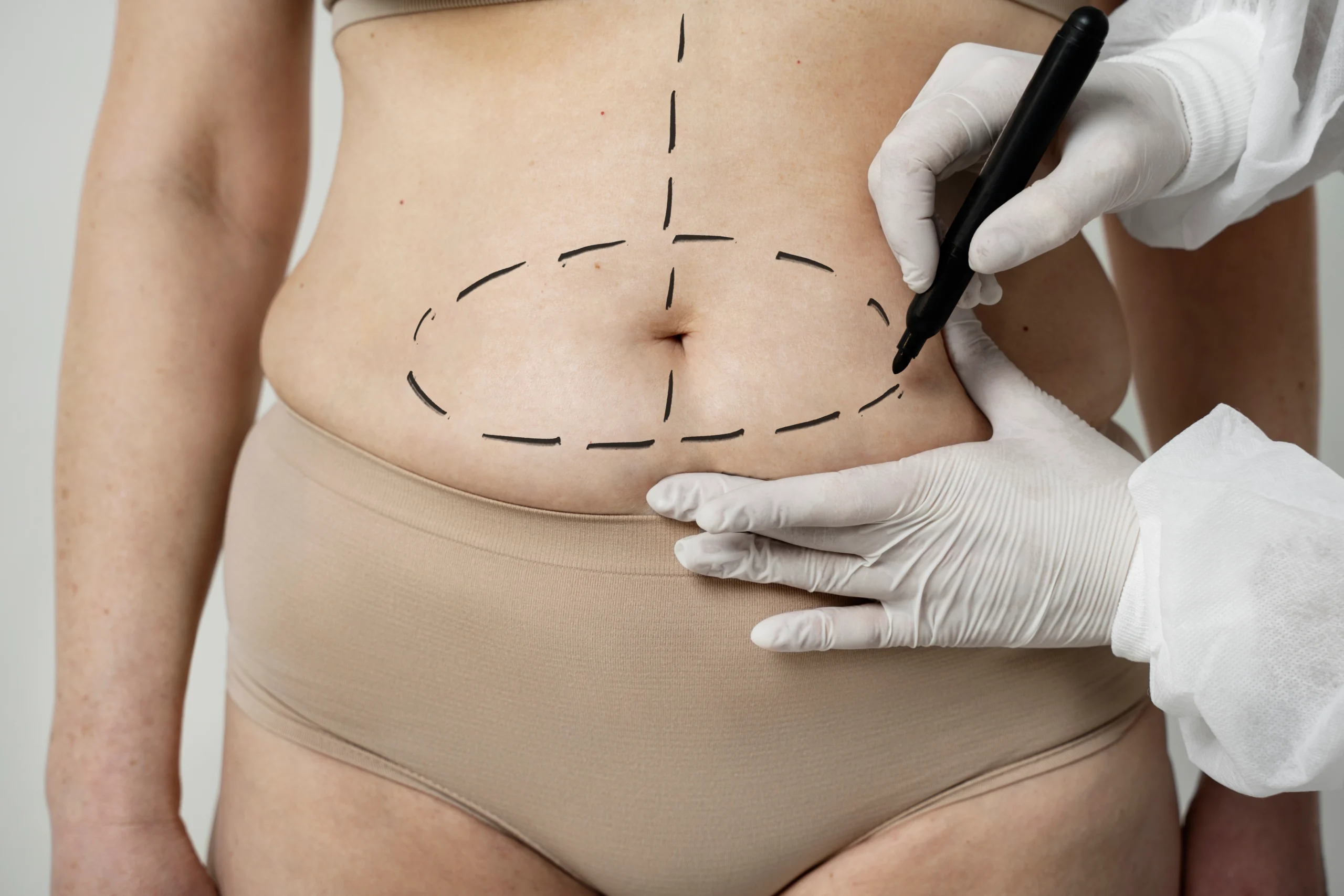
  • Mini Tummy Tuck vs Full Tummy Tuck: Which One Do You Need?

    Mini Tummy Tuck vs Full Tummy Tuck: Which One Do You Need?

    Short answer: In the mini tummy tuck vs full tummy tuck choice, the difference is the area treated. A mini tummy tuck treats loose skin and fat below the belly button only. It uses a shorter scar and the belly button stays where it is. A full tummy tuck treats the whole abdomen, above and below the belly button. It repairs separated abdominal muscles along their full length and repositions the belly button. Which one is right for you depends on where your loose skin is and on the state of your muscles, not just on how big your tummy looks.

    Many of my patients in Dubai come in asking for a mini tummy tuck because it sounds smaller and quicker. For the right person it is an excellent operation. For the wrong person it leaves loose skin above the navel and an unhappy patient. Here is how I decide between the two.

    What is a mini tummy tuck?

    A mini tummy tuck (mini abdominoplasty) removes a wedge of skin and fat from the lower abdomen through a short incision, low enough to be hidden by underwear or a swimsuit. The muscles below the belly button can be tightened if needed. The belly button itself isn’t moved.

    It is often combined with liposuction of the abdomen and flanks to improve the overall shape.

    Who is a good candidate for a mini tummy tuck?

    • You have a lower-belly “pouch” or loose skin below the navel only.
    • The skin above your belly button is reasonably firm.
    • Your muscles have little or no separation above the navel.
    • You are at or near a stable, healthy weight.

    What is a full tummy tuck?

    A full tummy tuck (abdominoplasty) uses a longer incision, usually from hip to hip and placed low. The skin of the whole abdomen is lifted. The separated abdominal muscles (rectus diastasis) are repaired from the breastbone down to the pubic bone. Excess skin is removed, and the belly button is brought out through a new opening in its natural position.

    In my practice I often combine it with liposuction, a technique called lipoabdominoplasty. This gives a more natural waistline and better-defined contours.

    When liposuction is combined with a tummy tuck or body lift, Dubai Health Authority (DHA) guidelines set the maximum permissible safe limit at 2,000 ml (2 litres) of fat. Liposuction on its own has a limit of 5 litres. Because the combined limit is lower, I choose the areas that will give the most benefit and keep your figure in proportion over the long term, rather than trying to remove as much as possible.

    Who is a good candidate for a full tummy tuck?

    • You have loose skin both above and below the belly button.
    • You have muscle separation after pregnancy, or a “bulge” that doesn’t go away with exercise.
    • You have stretch marks or loose skin after significant weight loss.
    • You are at a stable weight and have finished having children, or plan to wait.

    Mini vs full tummy tuck: side-by-side comparison

    Mini tummy tuckFull tummy tuck
    Area treatedBelow the belly buttonWhole abdomen, above and below the navel
    ScarShorter, low on the abdomenLonger, hip to hip, placed low
    Belly buttonNot movedRepositioned, with a new natural-looking opening
    Muscle repairLower abdomen only, if neededFull length, from breastbone to pubic bone
    Typical return to desk workAbout 1–2 weeksAbout 2–3 weeks
    Best forA lower-belly pouch with good skin tone abovePost-pregnancy changes, muscle separation, major weight loss

    Recovery times are a general guide. Your own timeline depends on your health, the extent of surgery and whether other procedures are combined.

    The most common mistake I see

    The most common mistake is choosing a mini tummy tuck to avoid a longer scar when the problem actually extends above the navel. The lower abdomen ends up flat, but the loose upper skin and the muscle bulge remain. This sometimes leads to a second operation.

    A well-planned full tummy tuck scar sits low and can usually be hidden under most underwear and swimwear. For the right patient, it gives a far better result than a mini procedure that doesn’t address the whole problem.

    What about the “extended” tummy tuck?

    If loose skin wraps around to the sides and hips, which is common after major weight loss, an extended tummy tuck carries the incision further round to treat the flanks as well. Patients with skin excess all the way around the body may need a body lift.

    Recovery in Dubai: what to expect

    • First 1–2 weeks: rest, a compression garment, and walking short distances to keep your circulation moving. You may walk slightly bent forward at first after a full tummy tuck.
    • 2–3 weeks: most people return to light activity and desk work.
    • 6 weeks: no heavy lifting or strenuous core exercise until about this point, especially after muscle repair.
    • 3–12 months: the scar gradually fades and softens.

    Dubai’s summer heat makes compression garments less comfortable, so many patients choose the cooler months for surgery. Wherever you are, stay hydrated and keep the scar out of direct sunlight for at least a year. See also how to prepare for plastic surgery.

    Safety first

    A tummy tuck is major surgery. It should only be done by a specialist plastic surgeon in a hospital licensed by the Dubai Health Authority. Before surgery I assess:

    • your medical history and blood tests
    • your risk of blood clots (DVT)
    • smoking status
    • weight stability
    • how much liposuction can be combined safely (a maximum of 2 litres with a tummy tuck or body lift, under DHA guidelines)

    Measures such as early walking and clot prevention are part of every plan. Read more about the risks of plastic surgery and how we reduce them.

    Which one is right for you?

    Only an in-person examination can answer this properly. During your consultation I:

    • check your skin above and below the navel
    • assess for muscle separation
    • check for hernias around the belly button
    • discuss your plans for future pregnancies

    I then recommend the procedure that will actually solve your concern. The final plan and quote are confirmed only after this examination.

    Not sure whether you need a mini or a full tummy tuck? Book a consultation with Dr Sanjay Parashar at Dubai London Hospital, Jumeirah.

    Frequently asked questions

    Is a mini tummy tuck less painful than a full tummy tuck?

    Generally, yes. A mini tummy tuck involves a smaller area and usually less muscle repair, so most patients find recovery shorter and more comfortable.

    Can a mini tummy tuck fix diastasis recti?

    Only if the muscle separation is limited to below the belly button. Separation that extends above the navel usually needs a full tummy tuck for a lasting repair.

    Will I have a scar after a tummy tuck?

    Yes. Both procedures leave a scar. It is placed low so that underwear or swimwear can usually cover it, and it fades over 12 to 18 months. A mini tummy tuck scar is shorter.

    Can I have a tummy tuck if I plan more children?

    You can, but future pregnancy can stretch the muscles and skin again. It is usually best to wait until you have finished having children.

    Is liposuction alone enough instead of a tummy tuck?

    If your skin has good elasticity and the problem is mainly fat, liposuction may be enough. If you have loose skin or muscle separation, liposuction alone can make loose skin look worse. A tummy tuck or lipoabdominoplasty is then the better option.

    How much liposuction can be done with a tummy tuck?

    Under DHA guidelines, the maximum permissible safe limit is 2,000 ml (2 litres) when liposuction is combined with a tummy tuck or body lift. Liposuction on its own has a limit of 5 litres.


    About the author: Dr Sanjay Parashar is a plastic and aesthetic surgeon in Dubai, operating at Dubai London Hospital, Jumeirah. He has performed more than 40,000 procedures, including over 10,000 liposuctions, and serves as ISAPS National Secretary for the UAE. He founded Cocoona Centre for Aesthetic Transformation in 2009.

    This article is for general information only and is not a substitute for a medical consultation. Results vary from person to person. All procedures carry risks, which will be discussed with you in detail during your consultation.